I have been in a complicated relationship with my air conditioning for most of my adult life.
I do not like manufactured air. What I love is a breeze. A real one. Window fan pulling air in on one side of the house, a window fan pushing air out on the other. That cross-ventilation situation where you can feel the house actually breathing. That is the good life.
And then August arrives in South Carolina and the negotiation begins. Comfort versus preference. The AC comes on because the alternative is suffering. But the moment there is a break in the heat- windows open. Fans on. House breathing again.
The same negotiation happens in Gambia. When the humidity climbs and the night heat becomes unbearable, the AC comes on there too. Two countries, same compromise. The window fan situation is the preferred state of being in both places, and I protect it whenever the weather cooperates.
I tell you all of this because how a house smells starts with how a house breathes. And for me, the two have always been in conversation.
It started with incense.
I was a teenager when I first started burning incense. Drawn to the ritual of it before I fully understood what I was doing. The thin sticks. The ash tray. The slow curl of smoke that changed the air in a room in a way that felt deliberate and slightly mysterious.
I did not know then that I was participating in one of the oldest human practices on earth. That what I was doing in my bedroom as a teenager was a version of what women in Africa and Asia had been doing for thousands of years- using scent to claim a space, to mark it as inhabited by a specific person with a specific presence- before the tradition moved throughout the Middle East and across the ancient world.
I just knew it made the room feel like mine.
That instinct has never left. It has only gotten more sophisticated.
What bakhoor taught me.
International travel changed everything about how I think about scent.
Bakhoor is an Arabic word for a blend of natural aromatic ingredients- primarily agarwood chips soaked in fragrant oils and combined with resin, ambergris, musk, and sandalwood. Heated on charcoal or an electric burner it releases a rich, perfumed smoke that does not just fill the air. It settles into it. Into curtains, carpets, fabric, hair. It lingers for hours after the burning has stopped.
In Middle Eastern households bakhoor is not decorative. It is daily. Women carry bakhoor burners through their homes, and both men and women stand over the burners to allow the smoke to perfume their clothing and hair- mixing and matching scents according to season, whim, or occasion.
That last part stopped me. This is not air freshener. This is a personal fragrance system for an entire home – as intentional and curated as a perfume wardrobe.
Bakhoor comes in varieties as distinct as perfume families. Oud bakhoor is deep, smoky, luxurious. Floral bakhoor leans into rose or jasmine. Sweet bakhoor settles into amber and vanilla for daily use. Herbal and spiced bakhoor is earthy and grounding, often used for relaxation or prayer.
The first time I walked into the home of someone from the Middle East where bakhoor had been burning I understood immediately why this tradition has survived for thousands of years. The air did not just smell good. It felt intentional. It announced that a woman with a specific sensibility lived here and had decided what her home would feel like before any guest arrived.
Scent as architecture.
Then came the Gambia. And chouriai.
West Africa introduced me to a different expression of the same ancient understanding.
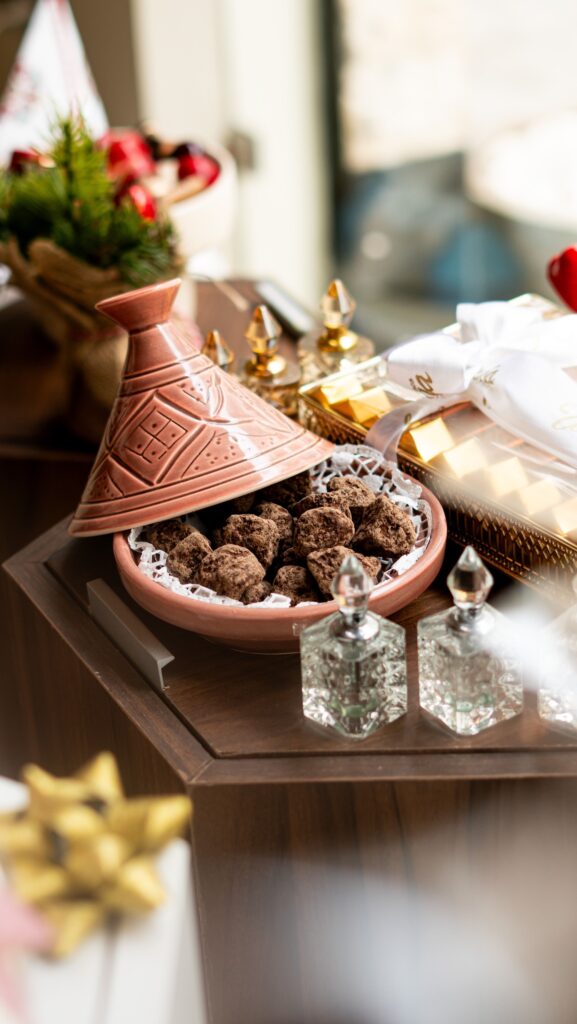
In The Gambia, Senegal, Mali, and Guinea the tradition is called Churray or Thiouraye- or as I know it, chouriai. It is a blend of wood shavings, aromatic seeds, fragrant herbs, and plant materials soaked in sandalwood, musk, oud, or amber. The scent is slightly spicy and peppery- earthy, organic, like something that grew in specific soil in a specific place.
Many Gambian homes begin their day by burning Churray, filling the house with its soothing scent that lingers throughout the day. The Andi Churray- a traditional terracotta or ceramic censer- is carried from room to room. The smoke moves through the house the way a breeze moves when the window fans are right. Every space. Every surface. And the house smells like itself for the rest of the day.
What makes chouriai truly special is that each family has its unique recipe. Passed from mother to daughter. Adjusted over generations. In Senegal, Thiouraye is described as so powerful that its enveloping scent bewitches men. Each woman creates her own composition and passes it to her daughter to ensure its durability.
A secret recipe. A woman’s scent signature carried across generations.
The distinction between the two.
Both bakhoor and chouriai share foundational ingredients – oud, sandalwood, amber, musk, resins. Both are carried room to room. Both linger in fabric and hair. Both are hospitality rituals and spiritual practices. Both are deeply personal.
But they are not the same.
Bakhoor tends toward the deeper, smokier, more resinous end of the spectrum. More formally luxurious. There is a ceremonial quality to it even when used daily.
Chouriai is earthier. Spicier. More peppery and organic. Where bakhoor announces, chouriai settles. It is less about ceremony and more about daily habitation. This is what the house smells like because this family lives here and this is who they are.
Both of them changed me. Together they shaped how I think about scent as a form of ownership over the spaces I inhabit.
What I know now that I did not know at fifteen.
A house that smells like something specific is a house that has been claimed.
Bakhoor smells like the woman who chose which blend for this season and stood over the burner and let the smoke settle into her space before her guests arrived. Chouriai smells like the family whose recipe has been passed down through three generations and whose home you would recognize by scent alone before you reached the door.
My house smells like me. That is the goal and has always been the goal, from the first incense stick I lit as a teenager to the chouriai burning in my compound in Gambia on a morning when the window fans are doing their thing and the air is moving through every room the way I like it.
For those in the US who want to start this journey – Etsy is the place. Small producers, authentic blends, women selling the same recipes their grandmothers made. Search bakhoor, search thiouraye, search chouriai or churray. You will find the real thing from people who have been making it their whole lives. Not a department store approximation. The actual tradition in a small jar shipped to your door.
The manufactured air has its place. The real air is better. And the scent that settles into both of them is mine.
That is not a small thing. That is the oldest form of home-making there is.
What does your home smell like- and is it intentional? Drop it in the comments.