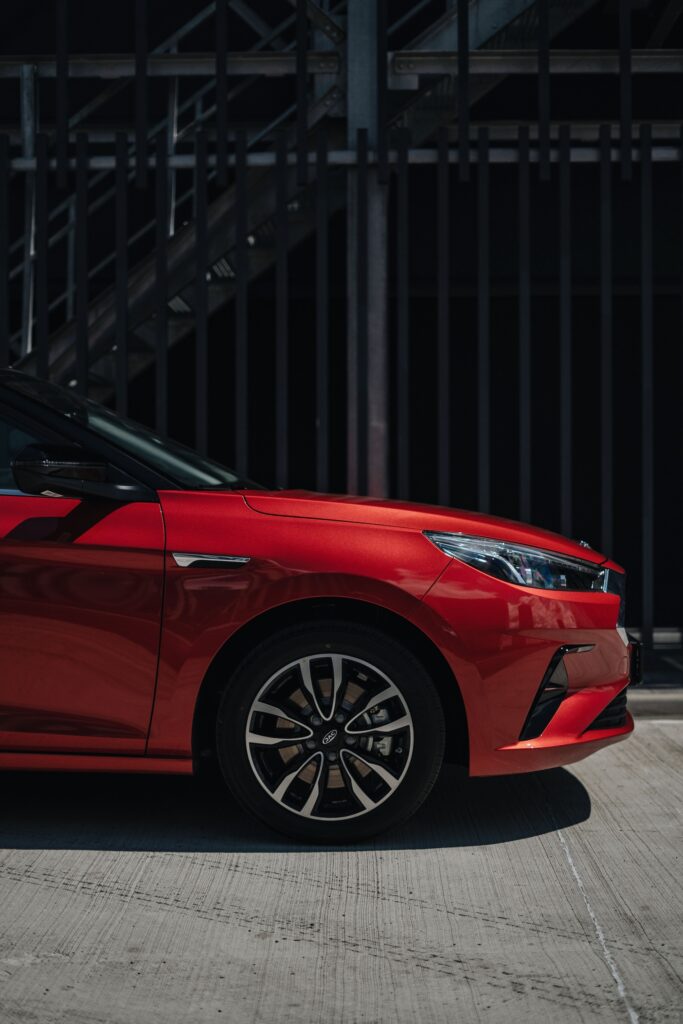
Let me tell you about a car you cannot have.
It is called the BYD Seagull. It is a fully electric five-door hatchback with a real-world range of up to 252 miles, LiDAR driver assistance technology, wireless connectivity, and build quality that reviewers consistently describe as exceeding its price point.
It starts at $10,300.
Not $10,300 down. Not $10,300 a year. Ten thousand three hundred dollars. Total. For a new electric car with technology that would cost you four times that amount from an American manufacturer.
In China, it was the top-selling vehicle of any kind – electric or gas – in November 2024. It ranked fifth in global EV sales in 2025 with nearly 450,000 deliveries. It is selling in Europe, Mexico, Brazil, Australia, and dozens of other markets around the world.
You cannot buy it in the United States.
The average new car transaction price in America right now is $49,275. The average monthly payment on a new car hit a record $772 in 2026. Twenty percent of new car buyers are paying $1,000 or more per month – the highest share ever recorded. The cheapest new car sold in the US is the Nissan Versa at $18,330 – nearly double the price of the Seagull.
And the government’s answer to a $10,300 electric car that the rest of the world is driving is: not here.
Let’s talk about why. And let’s be honest about what the real answer is.
The official reason.
The US government banned Chinese-origin software and hardware in connected vehicles citing national security. The argument goes like this: modern cars are rolling computers. They have GPS, cameras, microphones, sensors, and data systems. A car with Chinese software could theoretically collect data on American drivers, American roads, and American infrastructure – and send it back to Beijing.
This is not a made-up concern. Connected vehicle cybersecurity is a real issue. The White House cited evidence of China pre-positioning malware in American critical infrastructure. The concern about back doors in foreign technology is legitimate and documented.
I am not here to dismiss the security argument entirely.
I am here to ask why it only applies to China.
The question nobody in Washington wants to answer.
Toyota sold 2.5 million vehicles in the United States in 2025. Hyundai sold 1.8 million. Volkswagen, BMW, and Mercedes-Benz combined sold over a million. Honda sold 1.4 million. These are Japanese, Korean, and German companies – foreign companies – selling cars with foreign-developed software, foreign-built connected systems, foreign cameras and sensors and GPS modules collecting data on American drivers every single day. And here is what makes the selective ban even harder to defend: many of these same manufacturers use Chinese-made parts and electronics in the vehicles they sell in America. Chinese-sourced components are embedded throughout the global automotive supply chain – in semiconductors, battery cells, displays, and connectivity modules. The ban does not follow the parts. It follows the flag.
None of them are banned.
Not one of those manufacturers is subject to the same software restrictions being applied to Chinese automakers. Their connected systems are not being audited for back doors. Their data collection practices are not being scrutinized under national security frameworks. They are selling millions of cars in America and nobody in Washington is holding a press conference about the GPS data being processed in Tokyo or Seoul or Stuttgart.
So the question is not whether connected vehicle software poses a security risk. The question is why that risk apparently only exists when the software is written in Mandarin.
That is not a security policy. That is a geopolitical preference dressed up as a security policy.
Here is what they could have done instead.
The US government has significant experience requiring security modifications to foreign technology before it enters sensitive American systems. Defense contractors are required to meet specific cybersecurity standards. Foreign software used in government infrastructure undergoes security reviews. The concept of requiring audits, back door prohibitions, and mandatory code certifications is not novel. It is standard practice in every other sector where foreign technology touches American security interests.
They could have done the same thing with connected vehicles. Required every manufacturer – Chinese, Japanese, Korean, German, American – to submit their connected vehicle software for independent security audits. Prohibited specific data collection practices. Mandated that no vehicle software contain unauthorized back doors or remote access capabilities. Set universal standards and enforced them across the board.
That would have been a genuine security policy.
Instead, the rule specifically targets Chinese and Russian origin software and hardware while every other foreign manufacturer continues to operate without restriction. BYD designs the battery, makes the chips, and writes the software – roughly 75% of components are built in-house as one integrated system. The US government frames this integration as the problem. It is not. Apple modifies iOS for every market it operates in – China gets a different version than the US, with different data practices, different app availability, different system access. The iPhone is still an iPhone. The modification does not break the product. BYD could do the same thing. A market-specific software build that meets American security standards, audited and certified before it touches American roads, is not a technical impossibility. It is a business requirement that every other global technology company already navigates. The decision not to require it – and to ban the car instead – was a policy choice. Not a technical necessity.
Which was the point.
A disgruntled programmer in Detroit is also a threat.
Let me take the security argument one step further – because it deserves to be taken seriously enough to be fully examined.
If the concern is bad actors with access to connected vehicle systems, then geography is not your variable. Intent and access are your variables.
A disgruntled software engineer at Ford or GM has access to the same connected systems. Facts – an American defense contractor has been caught selling classified data. American technology employees have been prosecuted for selling user data. The insider threat is documented, real, and does not require a foreign government to orchestrate it. A bad actor with legitimate access to an American car’s software can do everything Beijing is theoretically accused of planning – and does not need to route it through China to do it.
If you are genuinely concerned about connected vehicle cybersecurity, the answer is universal standards with real enforcement. Audit every system. Certify every stack. Prohibit back doors in every vehicle sold on American roads regardless of where the code was written or who signed the paycheck of the person who wrote it.
That protects American consumers.
What exists right now does not protect American consumers. It protects American car companies from having to compete with a $10,300 electric vehicle.
The American taxpayer has already paid for this industry’s survival. Twice.
In 1979, Chrysler drove itself into the ground making gas guzzlers nobody wanted to buy during an energy crisis and went to Congress for $1.5 billion in loan guarantees. The American taxpayer obliged.
Thirty years later, GM and Chrysler came back. This time the bill was $80 billion. The government pumped money into both companies, their lending arms, and their restructuring through the Bush and Obama administrations. When the books finally closed, taxpayers had absorbed a net loss of over $9 billion. That is money that did not go to schools, infrastructure, healthcare, or the working people who needed it most.
Two bailouts. Decades apart. Same industry. Same failure to build a product people could afford and wanted to buy.
And now, when a $10,300 electric car shows up and proves that affordable, innovative transportation is actually possible – the answer from that same industry is not to compete. It is to call their friends in Washington and make sure the competition never reaches American shores.
If you cannot reinvent yourself after two chances and $80 billion in public money, the problem is not China. The problem is you.
Let’s name what this actually is.
China received $230.9 billion in government subsidies for its EV sector between 2009 and 2023. BYD used that investment to build the most integrated, most cost-efficient electric vehicle manufacturing system in the world. The result is a car that costs $10,300 and outsells everything else in the Chinese market including gas-powered vehicles.
American automakers cannot build that car. Not at that price. Not with that level of vertical integration. Not with a fragmented supply chain where Ford, GM, and Tesla each buy their technology from different vendors and cannot standardize around a single system. The American auto industry looked at what China built and concluded, correctly, that it cannot compete on product. So it competed on policy instead.
The 100% tariff on Chinese EVs. The connected software ban. The proposed Senate bill to permanently bar Chinese automakers from the US. These are not the actions of an industry confident in its own product. These are the actions of an industry that knows it is losing and has decided that keeping the competition out is easier than catching up.
And the American consumer is paying for that decision at the rate of $772 a month.
Who this actually hurts.
The person who needs a $10,000 reliable electric car is not living in a suburb with two car garages and a Tesla in the driveway. She is working class. She is commuting. She is making the impossible calculation between a car payment she cannot afford and no car at all in a country that has decided public transportation is optional.
She is disproportionately Black and brown. She is disproportionately the person who would benefit most from a $10,300 electric vehicle with a 190-mile range and zero gas costs. She is exactly the person the American auto industry has never built a car for – because she cannot afford what they are selling.
And she is being told that the $10,300 car that exists, that works, that the rest of the world is driving, cannot come here. Because national security.
Not because of national security. Because General Motors needs her to keep paying $772 a month.
What a real rule would look like.
I am not anti-regulation. I am anti-selective regulation that masquerades as protection while functioning as a monopoly.
A real connected vehicle security rule would apply to every manufacturer selling cars in the United States. Toyota. Hyundai. Volkswagen. BMW. Ford. GM. All of them. Universal audit requirements. Back door prohibitions for everyone. Mandatory data collection disclosures. Independent security certifications before any connected vehicle software touches American roads.
Set the standard. Enforce it equally. Let the market compete on price, quality, and innovation.
If BYD meets that standard – and there is no technical reason they could not, because software is code and code can be rewritten, audited, and certified – then the $10,300 car comes to America and the American consumer benefits.
If American manufacturers cannot build a competitive product at a competitive price point even on a level playing field, then that is information the American consumer deserves to have – and the market should respond accordingly.
What we have right now is not a level playing field. It is a protected mediocrity. And the people paying the price for it are the ones who can least afford to.
What would you do with a $10,300 reliable electric car? And what do you think this ban is actually about? Drop it in the comments.